The World’s Best Places to Stargaze from the Sea, Ranked
Most of us rarely see a truly dark sky. Cities, towns, and roads pour light into the atmosphere, creating a constant glow that washes out the stars and hides much of the universe from view. Even in places that feel remote on land, that faint haze of artificial light often lingers on the horizon.
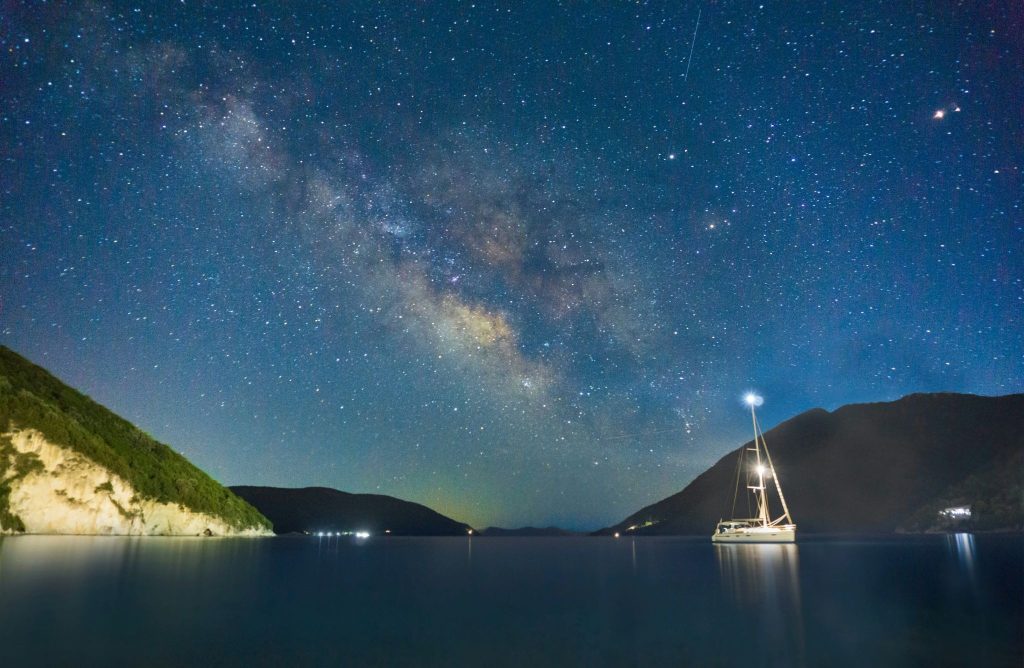
But step out onto the open sea, far from populated coastlines, and everything changes. The sky deepens, the stars multiply, and the Milky Way reappears in full, breathtaking detail.
To find the very best stargazing spots at sea, researchers measured sky darkness using something called an SQM (Sky Quality Meter) reading.
The SQM scale runs roughly like this:
- A score of 22 is essentially a perfect, pristine sky – as dark as it theoretically gets. You’ll see the Milky Way as a vivid, dense band across the heavens, and you may even be able to read by starlight alone.
- Between 21.5 and 21.9 is classed as “excellent” – the Milky Way is clearly visible, and the view will genuinely take your breath away.
- Between 21.0 and 21.4 is still very good, with some light glow on the horizon but otherwise beautiful, clear skies.
- Below 20, you’re in suburban or urban territory – the sky has that familiar orange-grey wash, and stargazing becomes more wishful than practical.
The Hebrides Coast, Scotland (SQM: 22)
Off the rugged western coast of Scotland, the Outer Hebrides sit in some of the darkest skies in all of Europe. These ancient islands are sparsely populated, buffeted by Atlantic winds, and blessedly far from any major city. On a clear night at sea here, you'll see the full sweep of the Milky Way, meteor trails, and more stars than most people ever see in their lifetimes. The surrounding North Atlantic scores a perfect 22 in open water, meaning that even as you approach the coast there's almost no deterioration in sky quality. Scotland also benefits from its northerly latitude, making it a candidate for the northern lights on top of everything else.
Baja California Coast, Mexico (SQM: 22)
Stretching along Mexico's Pacific side, the Baja Peninsula is one of the most sparsely developed coastlines in North America. The Sea of Cortez lies to the east and the open Pacific to the west – both extraordinarily dark, and the desert climate means reliably clear skies for much of the year.
Seychelles Outer Islands (SQM: 22)
Most visitors to the Seychelles stick to the main island of Mahé, but venture out to the remote outer islands and you enter a different world after dark. The Indian Ocean here is vast and completely unaffected by any nearby light pollution. The equatorial position means you can see stars from both hemispheres simultaneously – including the Southern Cross and the full arc of the Milky Way's centre. Some of the most extraordinary night skies accessible by sailing boat anywhere on earth.
Mozambique Coast (North) (SQM: 22)
Northern Mozambique remains one of Africa's least developed coastlines – and that remoteness is precisely what makes it so special at night. The Indian Ocean stretches dark in every direction, and the sky overhead is essentially untouched by human light.
Madagascar West Coast (SQM: 22)
Madagascar's west coast faces the Mozambique Channel – one of the darkest stretches of open ocean in the Indian Ocean basin. The island itself has very low levels of light pollution overall, and the western shore is the more sheltered and accessible side for sailors. Anchor off one of the many undeveloped bays here and the sky after sunset is extraordinary – dense with stars down to the horizon in every direction.
Raja Ampat Coast, Indonesia (SQM: 22)
Raja Ampat is already famous as one of the world's great diving destinations, but the skies above the water are as remarkable as what lies beneath it. This remote archipelago in the far east of Indonesia sits in the Western Pacific, surrounded by some of the darkest open ocean on the planet. The Banda Sea and the surrounding waters all score a perfect 22. Very little light pollution reaches this far from Indonesia's major population centres, and the result is a very impressive night sky.
Papua New Guinea Coast (SQM: 22)
Papua New Guinea is one of the least urbanised countries on earth, and its coastline reflects that entirely. Stretching along the Western Pacific with minimal infrastructure and almost no industrial development along its shores, it offers night skies that are as close to pristine as it's possible to find anywhere. The Bismarck Sea and the Solomon Sea, which border much of the PNG coast, both score a perfect 22 in open water.
Vanuatu Coast (SQM: 22)
The Vanuatu archipelago scatters across the South Pacific in a long chain of islands, most of them sparsely populated and far from any major shipping lane or industrial centre. The skies here are reliably excellent – warm, clear nights and a position well south of the equator give a wonderful view of the southern sky, including the Magellanic Clouds and the full sweep of the Milky Way's core.
Tonga Coast (SQM: 22)
Tonga sits deep in the South Pacific, one of the most isolated island nations on earth. Its small population, negligible industry, and position in one of the darkest ocean basins in the world make it a remarkable destination for anyone who wants to experience the night sky at its most unspoiled. The combination of warm water, calm anchorages, and ink-black skies makes stargazing here feel almost surreal.
French Polynesia — The Marquesas (SQM: 22)
The Marquesas are among the most remote inhabited islands on the planet, sitting roughly 1,500 kilometres northeast of Tahiti in the middle of the South Pacific. For blue-water sailors making the Pacific crossing, they are often the first landfall after weeks at sea – and the night sky on that passage, and around the islands themselves, is unforgettable. The Tuamotu Archipelago to the south scores a perfect 22 in open water.
The Best Stargazing Spots in the Mediterranean
The Mediterranean is the world's most popular sailing destination, and the good news is that much of it still offers genuinely excellent stargazing – if you know where to go. Here are the best coastal spots for dark skies in the Med.
1. Crete South Coast, Greece & Corsica West Coast, France (SQM: 21,93)
These two share the top spot and it's easy to see why. Crete's southern shore faces open sea toward Africa with almost no development along its rugged coastline. Corsica's west coast is similarly dramatic – steep mountains tumbling straight to the water, sparse population, and almost no light spill. On a clear night anchored off either of these shores, the Milky Way is a vivid, unmistakable presence overhead.
2. Dalmatian Coast (South), Croatia (SQM: 21,91)
The outer islands of southern Dalmatia are among the most unspoiled sailing destinations in Europe – and some of the darkest. Away from the charter-boat crowds and tourist infrastructure further north, this stretch of Croatian coast delivers exceptional skies. The further south and offshore you go, the better it gets.
3. Corsica East Coast, France/Italy (SQM: 21,9)
Corsica's eastern shore sits just a fraction below its western counterpart, still firmly in excellent territory. Less dramatic than the west coast but offering calmer anchorages, it's a quieter and often overlooked option for sailors wanting genuinely dark skies within easy reach of mainland Europe.
4. Greek Ionian Islands & Sardinia West Coast (SQM: 21,88)
The Ionian Islands are Greece at its most untouched – calm seas, sparse development, and skies that reward anyone who stays up past midnight. Sardinia's west coast matches them exactly, benefiting from open ocean exposure and a population density that mainland Italy simply can't compete with. Both are among the finest stargazing destinations in the entire Mediterranean.
5. Korcula Island, Croatia & Morocco Med Coast (SQM: 21,83)
Korcula is one of Croatia's hidden gems – wooded, quiet, and remarkably dark for an island so close to popular sailing routes. Morocco's Mediterranean coast surprises many sailors; relatively undeveloped and facing open sea, it holds its own comfortably against better-known destinations further north.
6. Vis Island, Croatia (SQM: 21,82)
Vis spent decades as a closed military zone, which inadvertently preserved both its natural environment and its darkness. Even now, with tourism slowly growing, it remains one of the least developed islands in the Adriatic – and the night sky reflects that perfectly.
7. Almeria Coast, Spain (SQM: 21,73)
Spain's Almeria coast is one of the country's best-kept secrets. Arid, sparsely populated, and facing open sea, it sits well clear of the light pollution that plagues much of the Spanish Mediterranean coast. It also benefits from some of the most reliably clear skies in Europe, thanks to its semi-desert climate.
8. Sicily South Coast, Italy & Ibiza North Coast, Spain & Kefalonia, Greece (SQM: 21,7)
Sicily's southern shore faces open sea toward Tunisia with minimal development. Ibiza's north coast is a world away from the clubs and resorts of the south – quiet bays, dark horizons, good skies. Kefalonia is one of the Ionian Islands' standout performers, large enough to have proper anchorages but unspoiled enough to keep the sky dark.
9. Hvar Island, Croatia (SQM: 21,68)
Hvar has a reputation as one of the Adriatic's most glamorous islands, but step away from the town and the skies tell a different story. The island's length and the darkness of the surrounding sea mean that a well-chosen anchorage away from Hvar Town will reward you with genuinely excellent stargazing.
10. Mallorca South Coast, Spain (SQM: 21,62)
Mallorca closes out the top ten – perhaps surprising for an island associated with mass tourism, but the south coast faces open sea and is considerably darker than the resort-heavy north and east. Choose your anchorage carefully and you'll find skies that most visitors to the island never see.
Set Sail Under the Stars
If reading this has you dreaming about dark anchorages and star-filled horizons, the next step is finding the right boat to get you there. Few experiences match falling asleep under a sky full of stars, miles from the nearest shore, with nothing between you and the universe but open water.
Navigare Yachting sells modern, well-equipped yachts ready to take you to the darkest skies on earth – whether that's a remote Dalmatian island, a South Pacific atoll, or an anchorage off the Outer Hebrides.
The stars are waiting. Browse our special offers and find yours.
Methodology
To identify the world's best locations for stargazing at sea, we analysed sky darkness across 85 coastal regions and sailing destinations worldwide using Sky Quality Meter (SQM) readings sourced from Light Pollution Map, which draws on VIIRS satellite data collected by NASA. SQM measures sky brightness in magnitudes per square arcsecond - the higher the value, the darker the sky and the better the conditions for stargazing. Readings were taken at coordinates positioned in open water near to coastlines, and locations were ranked from highest to lowest SQM score to determine the best and worst destinations for stargazing at sea.

Lagoon 55 vs Sixty 5: Which Catamaran Is Right for You?
What is charter management?
Introducing the New Lagoon 47

Ranked: The World’s Most Popular Sailing Destinations In 2026
Event Recap: An Afternoon With Navigare in Vero Beach
Why Place a Boat in Charter With Navigare Yachting
Why Buy a Boat in a Charter Program
World premiere: Lagoon 60